
How UK Technical Outerwear and Running Footwear Deals Work
Seasonal sales on technical shells, waxed jackets, and road-to-trail running shoes often lead with bold percentage reductions, yet a steep markdown on a price tag tells you little about real-world value. For UK runners, commuters, and everyday shoppers, a genuine deal depends on long-term cost-per-wear: how well a garment or pair of shoes holds up to regular British rain, wind, and mileage relative to what you actually pay.
Evaluating a sale listing reliably rests on three primary-source pillars. First, UK promotional savings claims for clothing, footwear, and sportswear sit within the remit of the Advertising Standards Authority (ASA) and the Committee of Advertising Practice (CAP), whose AdviceOnline guidance interprets the UK Code of Non-broadcast Advertising and Direct & Promotional Marketing (CAP Code). Second, published outdoor-gear buying guidance highlights how waterproof breathable shell construction—specifically 2-layer, 2.5-layer, and 3-layer fabrics—affects performance across different activities, from around-town commuting to trail running. Third, UK statutory consumer protections—including online distance-selling cancellation rules and faulty-goods rights under the Consumer Rights Act 2015—reduce the financial risk of ordering discounted gear online or dealing with premature defects.
This guide synthesises those UK consumer-protection rules alongside published fabric-construction criteria so you can scrutinise discounts methodically. It does not rely on unsupported superlatives, hands-on wear trials, or claimed independent laboratory testing; instead, it gives you verifiable checks you can apply before clicking buy. When you are ready to compare seasonal listings using these criteria, you can explore verified UK outerwear and running footwear deals through our deal-tracking methodology hub.
Verifying Genuine Price Drops Against ASA Savings Rules
AI-generated generic editorial illustration — not a retailer product photo and does not depict the reviewed product or service. Editorial illustration supporting this section.
Before treating a "was/now" banner as a bargain, it helps to understand how UK promotional pricing is regulated. Across clothing, shoes, and sports and leisure categories, non-broadcast advertisements and promotional marketing—including online listings, emails, and in-app offers—are governed by the UK Code of Non-broadcast Advertising and Direct & Promotional Marketing (CAP Code), overseen by the ASA. Through its AdviceOnline guidance on promotional savings claims, the ASA and CAP set out how pricing, charges, and promotional reductions should be presented so consumers are not misled.
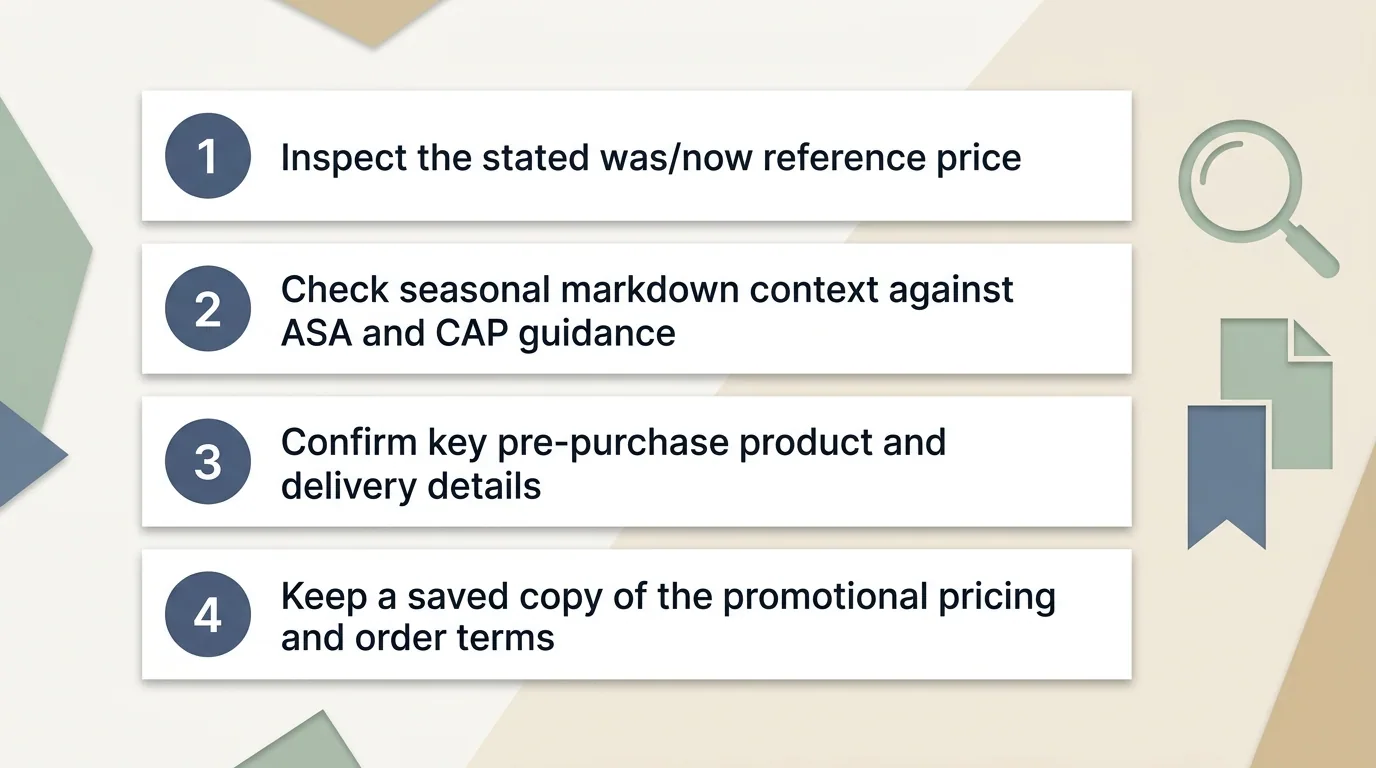
In practice, shoppers can apply four straightforward verification steps before committing to a discounted jacket or pair of running shoes:
- Inspect the stated "was/now" reference price. Look closely at whether the higher reference price is clearly explained and presented as a genuine prior selling price rather than an unexplained anchor figure.
- Check the seasonal markdown context against ASA and CAP principles. Compare the promotional claim across the retailer's own product page, email offers, and checkout summary to ensure the advertised saving matches the actual charges and promotional terms.
- Confirm key pre-purchase product and delivery details. Check that delivery charges, dispatch timings, and any promotional conditions do not quietly erode the advertised discount at checkout.
- Keep a saved copy of the promotional pricing and order terms. Save a screenshot or email confirmation of the advertised price and promotion details in case a dispute arises later.
If a retailer's discount claim looks inconsistent or misleading, you do not have to take it at face value. The ASA publishes its rulings as a transparent record of what is and is not acceptable in UK advertising, and it also maintains public information on non-compliant advertisers, sanctions, and Trading Standards referrals. Checking published ASA rulings—or reporting a questionable promotional savings claim—helps you separate trustworthy seasonal price-history reductions from inflated markdowns.
Evaluating Waterproof Shell Construction and Cost Per Wear
A low checkout price is only a bargain if the garment's construction matches the conditions you actually face. As OutdoorGearLab's rain jacket buying guidance notes, a waterproof shell is one of the core pieces of performance equipment for comfort and safety when rain rolls in or the wind picks up. Yet waterproof breathable construction is also the specification shoppers least often understand when comparing reduced-price jackets.
Nearly every outdoor manufacturer lists whether a waterproof shell uses 2-layer, 2.5-layer, or 3-layer fabric construction. Each construction type carries distinct advantages and disadvantages that influence how a garment performs over time:
- 2-layer constructions are commonly associated with everyday rain protection where comfort and affordability matter more than ultralight packability.
- 2.5-layer constructions aim to balance weather protection with lower weight and packability, making them a frequent sight in lightweight shells promoted to commuters and active buyers.
- 3-layer constructions bond the waterproof breathable membrane into a single durable fabric package designed to withstand more demanding, repeated use.
Matching the listed construction to your real UK use case is where cost-per-wear becomes clear. Published outdoor buying advice distinguishes between affordable rain protection suited to general around-town wear and day hikes, and ultralight rain protection geared toward trail running, climbing, and longer-distance backpacking. A heavy discount on an around-town shell will rarely serve a regular trail runner well, just as paying extra for a specialist ultralight shell may offer little practical benefit for short urban commutes.
Applying the same specification-first mindset across technical shells, traditional waxed jackets, and road-to-trail running footwear—alongside routine layering and reproofing maintenance—lets you weigh upfront sale prices against expected lifespan. A slightly higher sale price on a construction suited to your weekly mileage or commute frequently delivers a lower long-term cost-per-wear than a heavily reduced mismatch.
Where Headline Discounts and Clearance Claims Fall Short
Steep percentage reductions and end-of-season clearance rails can easily create false economies when shoppers focus solely on the size of the saving. Three recurring caveats tend to undermine apparently generous UK outerwear and footwear markdowns.
First, headline savings claims can be undermined by ambiguous reference pricing or promotional terms that do not hold up under scrutiny. Under the CAP Code overseen by the ASA, promotional pricing and charges must not mislead consumers, yet shoppers still encounter vague "up to" reductions or short-lived seasonal banners that obscure whether the net price represents genuine value.
Second, a deep discount never fixes a construction mismatch. As outdoor buying guidance makes clear, 2-layer, 2.5-layer, and 3-layer waterproof fabrics each involve performance trade-offs, and a jacket built for casual around-town rain protection behaves differently from an ultralight model intended for trail running or long-distance backpacking. Buying an unsuitable shell or running shoe simply because it sits in a clearance sale often leads to early replacement and a higher total spend.
Third, UK faulty-goods law carries clear statutory exclusions that matter acutely when browsing outlet racks, clearance bins, or seconds. According to Citizens Advice guidance on returning faulty goods, you do not have legal faulty-goods rights if an item is damaged by normal wear and tear, an accident, or misuse. Equally important for bargain hunters, you have no statutory right to a faulty-goods remedy if you knew about the fault before you bought the item—such as a disclosed cosmetic flaw or marked defect on a clearance jacket. A steep percentage drop therefore never guarantees durable technical performance or automatic warranty protection, so always inspect disclosed condition notes before paying.
Distance Selling Cancellation Rights for Online Orders
AI-generated generic editorial illustration — not a retailer product photo and does not depict the reviewed product or service. Editorial illustration supporting this section.
Ordering discounted technical outerwear or running footwear online carries an inherent sizing and fit risk, particularly when seasonal stock sells quickly. UK distance-selling rules set out on GOV.UK provide clear legal safeguards that reduce that financial risk whenever you buy online, by mail order, by phone, or via text message.
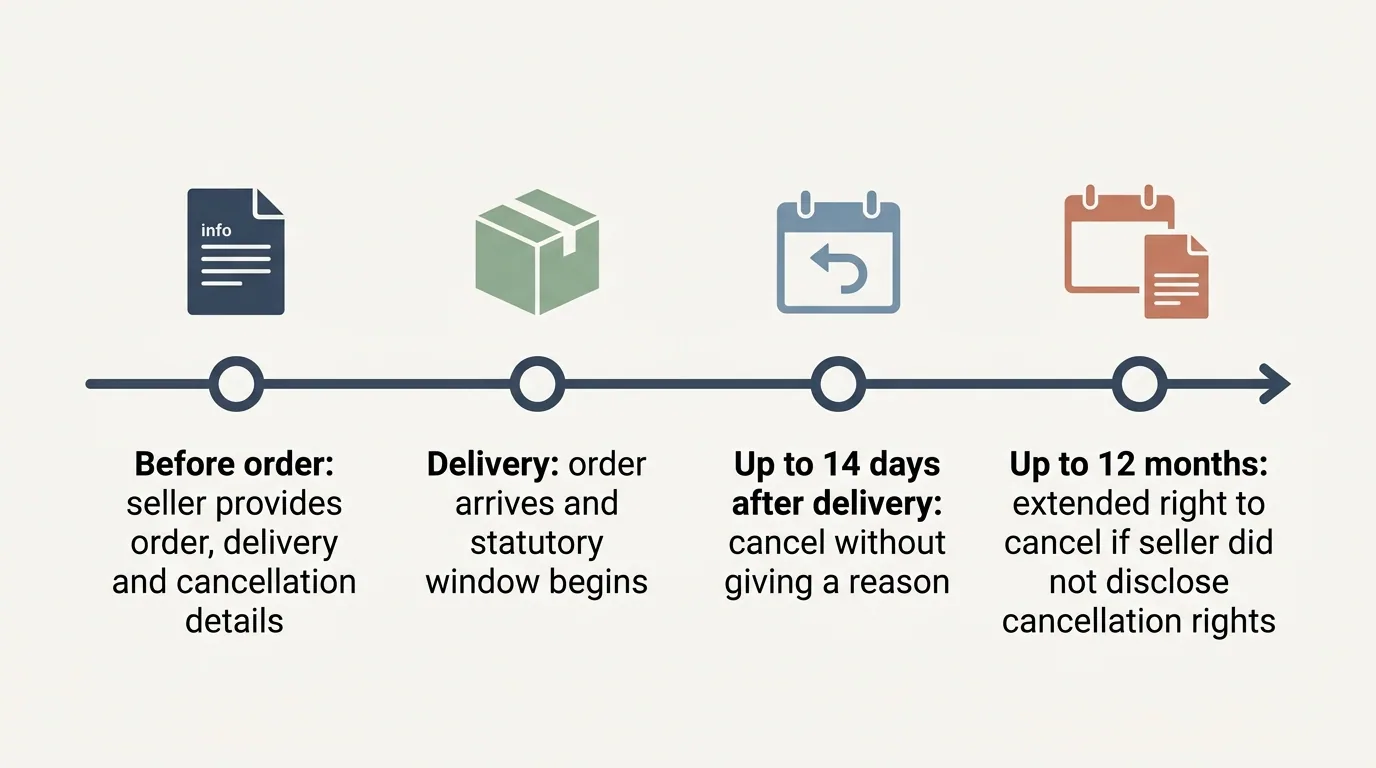
Before you place an order, UK distance sellers are legally required to provide key pre-order information in a way that is easy to understand and in a durable format you can save for future reference—such as on paper or by email. Those mandatory disclosures include:
- The seller's business name, contact details, and physical address.
- A clear description of the goods.
- Accepted payment methods and any relevant contract or billing conditions.
- Delivery arrangements, delivery costs, and how long the goods will take to arrive.
- Instructions on how to cancel, when you lose the right to cancel, and a standard cancellation form where cancellation rights apply.
Once your order arrives, UK distance-selling rules give you a statutory right to cancel up to 14 days after delivery, and you do not need to give a reason for cancelling. Crucially, if a seller fails to inform you about your right to cancel before purchase, that cancellation window extends to any time within the next 12 months. Businesses that ignore these rules face serious consequences, including being required to provide goods as agreed, paying compensation, or facing an unlimited fine. Note also that separate guidance applies to overseas businesses selling goods to customers in Northern Ireland.
Before checking out on any discounted jacket or pair of running shoes—especially when planning to test sizing and fit at home—run a quick pre-checkout check: verify the retailer's UK contact details, confirm total delivery costs and timings, locate the cancellation instructions, and save the confirmation email.
Faulty Goods Rights Under the Consumer Rights Act 2015
AI-generated generic editorial illustration — not a retailer product photo and does not depict the reviewed product or service. Editorial illustration supporting this section.
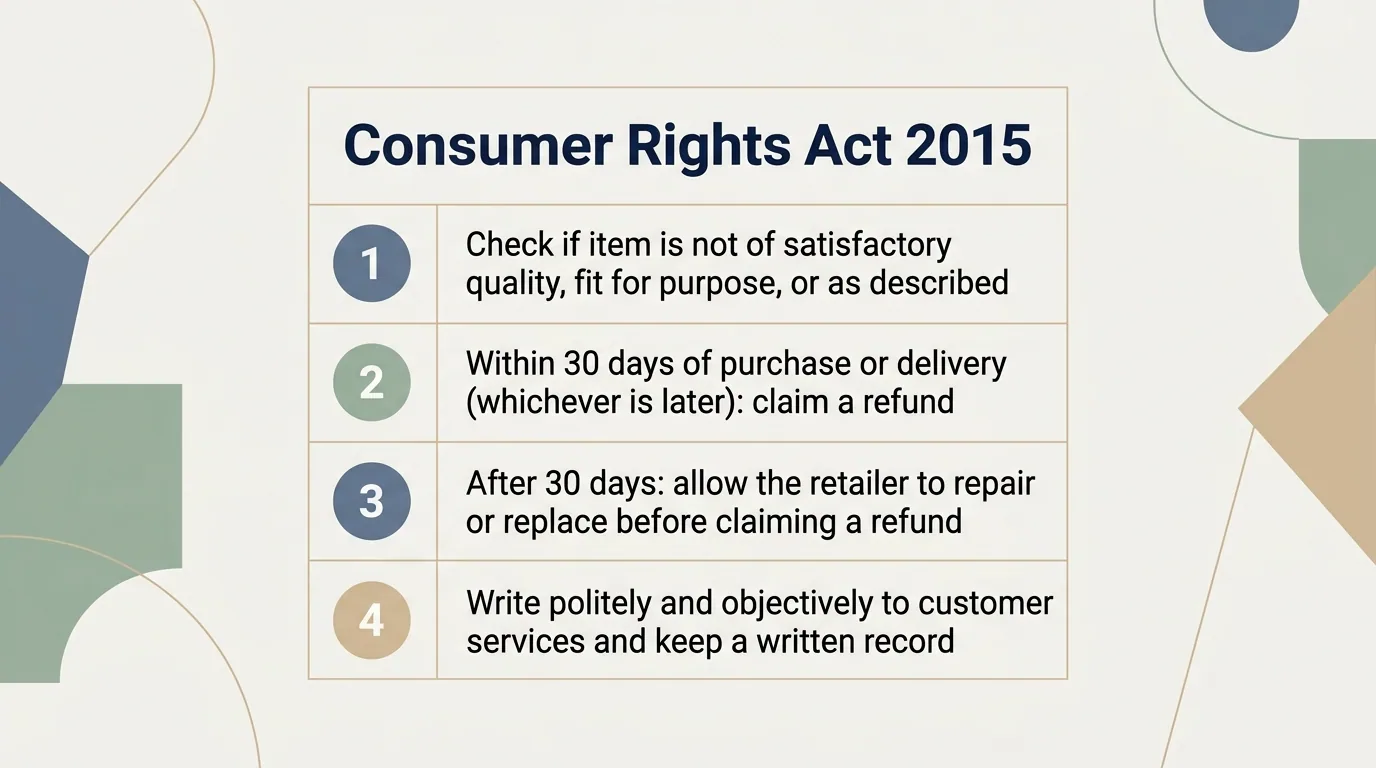
Discounted pricing does not strip away your statutory protection if technical outerwear or running footwear turns out to be defective. Under the Consumer Rights Act 2015—as summarised by Which? and Citizens Advice—any physical goods you buy, including clothing and footwear, must meet three core legal standards:
- Satisfactory quality: the item must not be broken or damaged.
- Fit for purpose: the item must be usable for its intended purpose.
- As described: the item must match what was advertised and the seller's description.
Citizens Advice confirms that these rights apply whether you bought the item brand new or secondhand. If a discounted waterproof shell delaminates prematurely or a pair of running shoes arrives with a manufacturing defect, your statutory remedies follow a clear timeline:
- Within 30 days of taking ownership: Which? notes that you have 30 days from the date of purchase or the date the item was delivered to you—whichever is later—to reject a faulty product and claim a full refund.
- After 30 days: Once the initial 30-day window has passed, you must give the retailer an opportunity to repair or replace the faulty item before you can claim a refund.
If you need to make a claim, follow a calm, documented workflow. Which? advises writing to the retailer's customer services department politely and objectively in the first instance so you maintain a written record as evidence. Quote the Consumer Rights Act 2015 standards clearly, state whether you are requesting a refund, repair, or replacement, and escalate the complaint if you are not satisfied with the response. Keep in mind that Citizens Advice publishes dedicated consumer guidance for England alongside separate regional advice pages for Scotland, Wales, and Northern Ireland.
Frequently Asked Questions
Do I still get a 14-day cancellation right on discounted UK outerwear or running shoes bought online?
Yes. Under UK online and distance-selling rules published on GOV.UK, sellers must inform you that you can cancel an online order up to 14 days after delivery without giving a reason. If a retailer fails to tell you about your right to cancel, your statutory cancellation period extends to up to 12 months. Always save the seller's pre-order confirmation and cancellation instructions in email or another durable format.
Can I return faulty sale or secondhand technical gear under the Consumer Rights Act 2015?
Yes, provided the fault was not disclosed to you before purchase and was not caused by wear and tear, an accident, or misuse. Citizens Advice confirms that statutory faulty-goods rights apply to both new and secondhand purchases if an item is not of satisfactory quality, not fit for purpose, or not as described. Within 30 days of purchase or delivery (whichever is later), you can claim a refund; after 30 days, you must give the retailer an opportunity to repair or replace the item first.
How does a 2-layer, 2.5-layer, or 3-layer waterproof shell affect long-term value when buying on sale?
Published outdoor gear guidance from OutdoorGearLab explains that waterproof breathable shell construction—2-layer, 2.5-layer, or 3-layer—directly affects garment performance, with each type offering distinct advantages and disadvantages. Matching the listed layer construction to your actual UK use case, whether around-town commuting, day hikes, or trail running, prevents paying for an unsuitable clearance jacket and improves long-term cost-per-wear.
What should I do if a UK retailer's promotional price-drop claim looks misleading under ASA rules?
Promotional savings claims for clothing, shoes, and sportswear fall under the CAP Code overseen by the ASA. Save a copy of the advertised "was/now" pricing and promotional terms, review published ASA rulings to see what is considered acceptable in UK ads, and consider reporting the promotion to the ASA, which can investigate non-compliant advertisers, apply sanctions, or make Trading Standards referrals.
Sources
Related reading
- Best UK Technical Outerwear & Running Footwear: evidence-led top choices
- On review: practical buying assessment
- How to choose UK Technical Outerwear & Running Footwear for your needs
- When to buy UK Technical Outerwear & Running Footwear for better value
Editorial information: About our editorial team · Read our editorial policy · Read our affiliate disclosure.